WHAT WE BELIEVE
We say what we believe out loud, together, every time we meet.
This church holds to the Apostles’ Creed and the Nicene Creed, and says one of them aloud with the whole room most weeks. Both are printed here in full. You should not have to wonder what a church believes, or take anyone’s word for it, so the shortest way to find out what we hold is to read them.
The short version
Four short answers, then the creeds themselves, then what all of it looks like on a Friday evening. Open a row to read it.
The creeds also mark a boundary. They set out what has to be believed here, and by saying nothing about a great many other things they leave those free.
See also: Membership and Governing documents.
A short summary
The gospel, as this church preaches it, is that God forgives sin through Jesus Christ, welcomes people into his own house, and makes a genuinely different kind of life possible, beginning now and finished in eternity. That is not a claim that anyone here has stopped sinning. It is a claim that there is real hope of a different life.
None of it is earned. Good works follow from faith as a response to a gift already given, and this is the order they come in.
What we hold about God, about Jesus and about the Holy Spirit is set out in the two creeds below, and Scripture is what norms all of it, the creeds included.
What Christians have always held
The creeds are the oldest short summaries of the Christian faith. What they say goes back to the earliest centuries, before any of the divisions that came later, and churches of very different kinds still say one or both of them. This church affirms the Apostles’ Creed and the Nicene Creed, and both are printed in full further down this page.
We say them because they were handed to us, not because we picked them. A creed is not a preference and it is not a house style. Saying one aloud, together, on a regular basis is what makes a church’s belief public and accountable: nobody has to wonder what we hold, because we say it where anyone can hear.
What we hold with our wider fellowship
Trinity Christian Fellowship is an independent congregation and is not affiliated with any denomination. We are not on our own, though. This church was planted out of Lexington Christian Fellowship and belongs to a small group of churches that grew from it, held together by relationships rather than by a constitution. We received most of how we do things from them and are glad of it.
We do not hold that other churches ought to do it our way. The way we do church is the way we do church, and it is not a pattern we would press on anybody. We work alongside churches that do things differently from us, and we would much rather commend Jesus than commend ourselves.
One of the places that happens in public is the Mars Hill Forum, a free evening with a serious speaker on the University of Kentucky campus. You do not have to be a Christian to come, and it is not really aimed at people who already are.
How we practice this here
Belief and practice are meant to be one thing, so the rest of this page describes an ordinary Friday evening and why it is shaped the way it is: the reading and the preaching, the Lord’s Supper at the end of every week, baptism, the gifts of the Spirit, and how the church decides things.
A creed is a short summary of the Christian faith, written down early and said together ever since. Both of ours are below, in the wording this church uses when it says them.
The Apostles’ Creed
The shorter of the two, and the older in shape. It grew out of the questions put to people at their baptism in the early centuries of the church, which is why it runs as one person’s answer rather than a congregation’s. Saying it commits you to all of it and in this order: the Father who made everything, the Son who was born, died, rose and will return, the Holy Spirit, the church, and the raising of the body at the end.
I believe in God the Father almighty, maker of heaven and earth; and in Jesus Christ his only Son our Lord, who was conceived by the Holy Spirit, born of the Virgin Mary, suffered under Pontius Pilate, was crucified, dead, and buried: he descended into hell; the third day he rose again from the dead; he ascended into heaven, and sitteth on the right hand of God the Father almighty; from thence he shall come to judge the quick and the dead. I believe in the Holy Spirit; the holy catholic church; the communion of saints; the forgiveness of sins; the resurrection of the body, and the life everlasting.
A note on one word. In both creeds, “catholic” means universal: the whole Christian church of every time and every place. It does not mean the Roman Catholic Church.
The Nicene Creed
The longer one, and the one the churches worked out together at two councils in the fourth century. Nicaea settled the question that would not go away, whether Jesus Christ is God in the same sense the Father is or something less than that, which is why the sentences about the Son run to such length. Constantinople settled the same question about the Holy Spirit, and added the words about the Spirit, the church and the resurrection that close it. It sits beside the shorter creed because the short one says what we hold and the long one says why the wording matters.
I believe in one God, the Father Almighty, Maker of heaven and earth, and of all things visible and invisible.
And in one Lord Jesus Christ, the only-begotten Son of God, begotten of the Father before all worlds; God of God, Light of Light, very God of very God; begotten, not made, being of one substance with the Father, by whom all things were made.
Who, for us men for our salvation, came down from heaven, and was incarnate by the Holy Spirit of the virgin Mary, and was made man; and was crucified also for us under Pontius Pilate; He suffered and was buried; and the third day He rose again, according to the Scriptures; and ascended into heaven, and sits on the right hand of the Father; and He shall come again, with glory, to judge the quick and the dead; whose kingdom shall have no end.
And I believe in the Holy Ghost, the Lord and Giver of Life; who proceeds from the Father; who with the Father and the Son together is worshipped and glorified; who spoke by the prophets.
And I believe one holy catholic and apostolic Church. I acknowledge one baptism for the remission of sins; and I look for the resurrection of the dead, and the life of the world to come. Amen.
How we practice this
A Friday evening
We meet on Friday evenings in the sanctuary at Anchor Baptist Church. Anchor Baptist is a different congregation; we are their guests one evening a week.
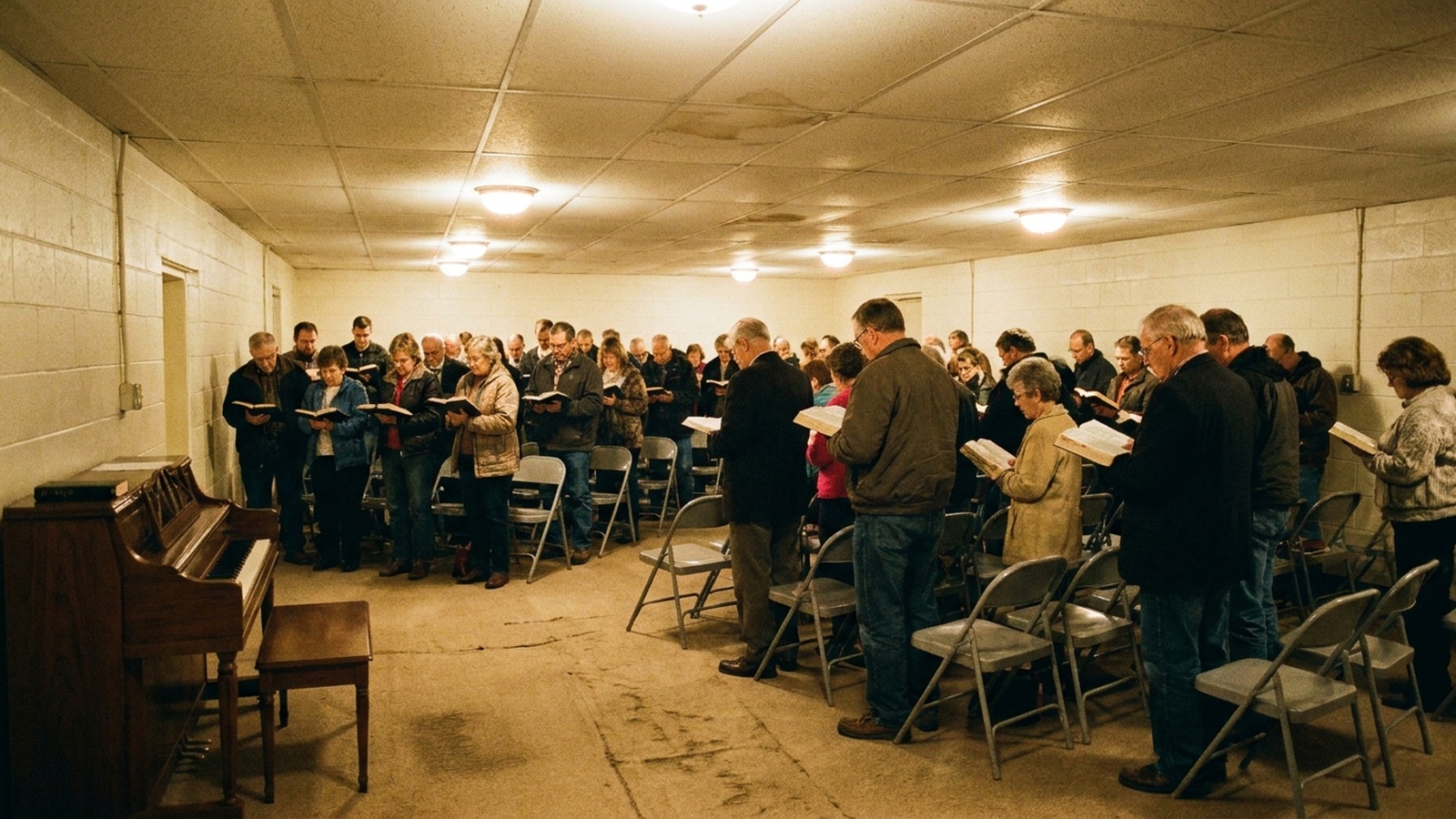
The evening is built around two things, the word of God read and preached, and the table. It is deliberately not built around a musical experience, and the pastor has said from the front that this can make it feel disjointed to somebody used to a service that is. There is usually a confession of sin near the beginning, to remind everybody that we are about to come into God’s presence. There is more Scripture read aloud than there was a few years ago, and the intention is more still. Every gathering ends with the Lord’s Prayer, said by the whole room.
Nobody is made to say the creed or the prayer out loud. What the creed says is a different matter: the church holds its content to be settled rather than optional, because the gospel is in it.
Afterward people stay and talk, and that is not incidental. It is one of the things this church values most about itself. Plan your visit has the same evening from the outside: parking, which door, how long it runs.
The gifts of the Spirit
We believe every spiritual gift the New Testament describes is still given to the church, even the ones we do not often see, and we practice them. That includes gifts of healing, which we have seen, and speaking in tongues with interpretation. You are not especially likely to meet all of them on a Friday evening; tongues and interpretation are used mostly in smaller and more familiar settings than the gathering.
How a room feels is not how we measure any of this. It is easy to mistake high spirits for the Holy Spirit, and real spiritual experience goes deeper than emotional intensity.
The preaching
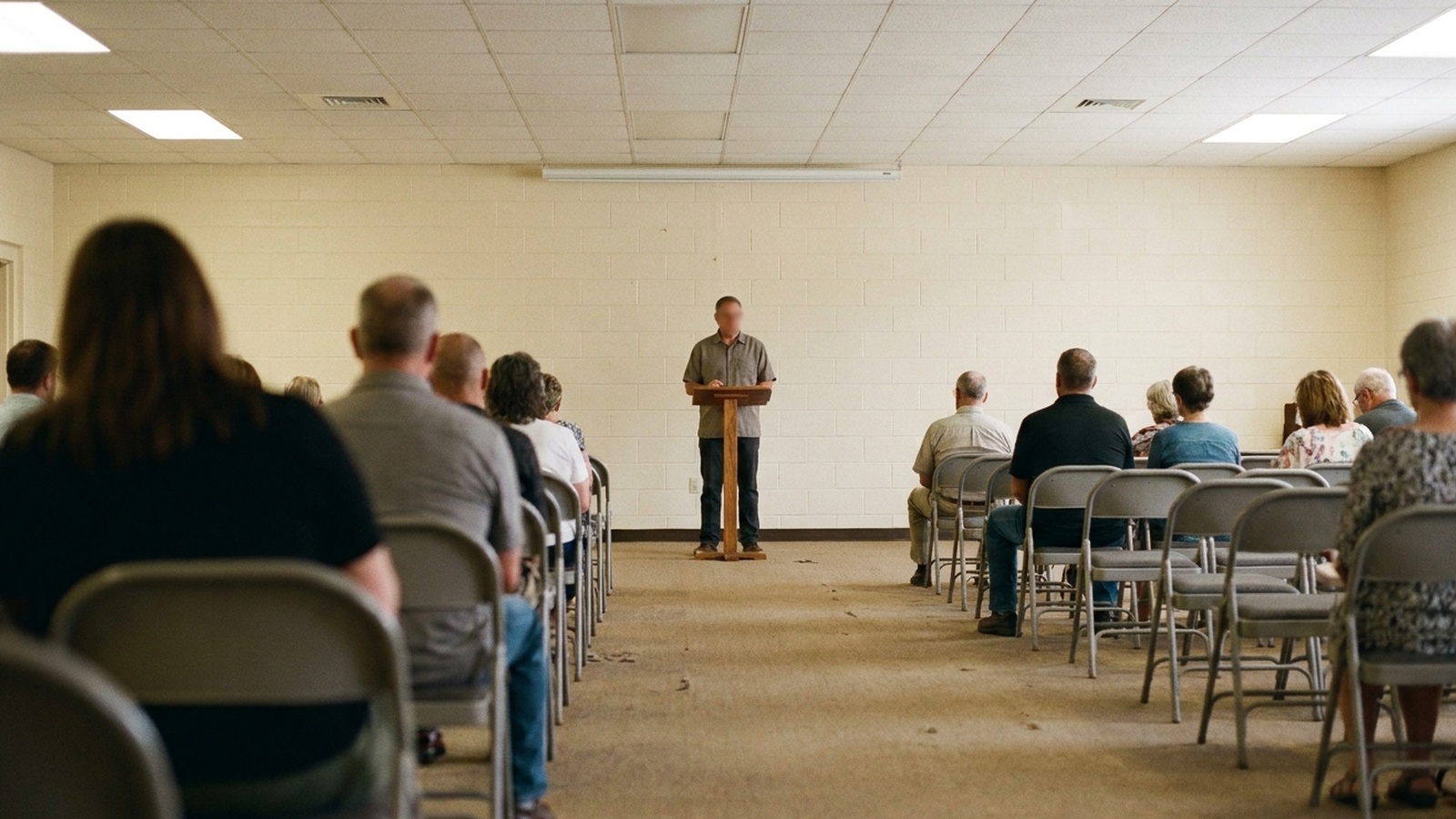
Chad and Kelly preach through whole books of the Bible, a passage at a time, and let the text set the subject. That is why you will not find a sermon here called seven ways to have a Christ-filled marriage. The cost is real and they say so: on any given Friday the passage may not speak to the thing you are most worried about. What you get in exchange is that nothing gets skipped, including the parts nobody would have chosen.
The Lord’s Supper
A note on three words. The Lord’s Supper, the Lord’s table and communion are three names for one thing: the bread and the cup, taken together at the end of a Friday evening. This section uses all three. The rest of the site says communion.
We take the Lord’s Supper every Friday, and the evening is built so that it ends there. We believe it is, as some theologians have called it, a means of grace: that by the power of the Holy Spirit, Christ is really present in this meal that he told us to keep. How that happens, we do not try to say. Christians have fought bitterly over the mechanism for centuries, and we are content to assert that the Lord meets us at his table without explaining how he does it.
We take Paul’s warning about discerning the body to be about how the people in a church treat one another, rather than about holding the wrong theory of the bread and the wine.
The bread and the cup are for baptized believers in Jesus who intend to try to put his teachings into practice, and that is said out loud most weeks so nobody has to guess. The baptism does not have to have happened here. If you were baptized at another church and you are following Jesus, that is the baptism this is talking about.
If that is not you, stay in your seat. When the time comes, people get up and go down to the front, families usually going together and praying as they take it, and the worship team sings through the whole of it. Coming to the evening and coming to the table are two different invitations, and the first one stands either way.
Whether to take it on a given Friday is, first of all, a question you answer for yourself. If you are a Christian who is living in ongoing, unrepented sin that Scripture clearly condemns, and you do not intend to stop, that is one good reason to let the bread and the cup pass this week rather than to take them.
If you are still not sure whether this includes you, ask Chad or Kelly before the evening starts.
Baptism
We believe we are baptized because of our faith, and that the Christian life begins at baptism. It is a confession of sin and a dying with Jesus, a real sharing in what happened to him: his death, his resurrection, and his ascension into the Father’s presence. When someone here falls into sin, the counsel they get is to flee back to their baptism and to the faith they put in Christ at the beginning.
We baptize by immersion, and we tend to practice believer’s baptism, meaning somebody old enough to understand the faith and to profess it themselves. We also respect Christians who baptize their infants: if you were baptized as a child, we will not ask you to be baptized again as an adult. We have our convictions about how and whom you baptize, and they are not something we would divide over.
Baptisms happen on a Friday evening, in front of the whole church. There is no emotional altar call here; the appeal is to your will rather than to your feelings, and it can be arranged quickly once someone has made up their mind.
If baptism is something you have been turning over, say so to Chad or Kelly on a Friday evening, or email info@tcfky.com.
How decisions get made
Christ rules, elders lead, the congregation discerns. That is the whole thing in seven words, and the church is moving toward a congregational structure that makes it formal.
It is not one man, or a small group, deciding without accountability and without submitting to Scripture. Neither is it majority rule, which is a different thing from a congregation working out together what the Spirit of God is saying to one small part of the body of Christ, and the second is what is being aimed at.
Elder, overseer, presbyter and pastor all name one office here, and everyone in the congregation carries responsibility, from an elder to the youngest member. A proposed ordination goes to the whole congregation first, to pray over and ask questions about, and if nobody has serious concerns the church hopes to go ahead. Correction belongs to the whole body rather than to the leaders alone, and so does restoring somebody afterward. Excluding a person from the fellowship belongs to the whole body as well, and the church calls that a last resort.
The formal version, with the wording that binds, will be in the constitution and bylaws on governing documents.